AI document extraction is only the first step
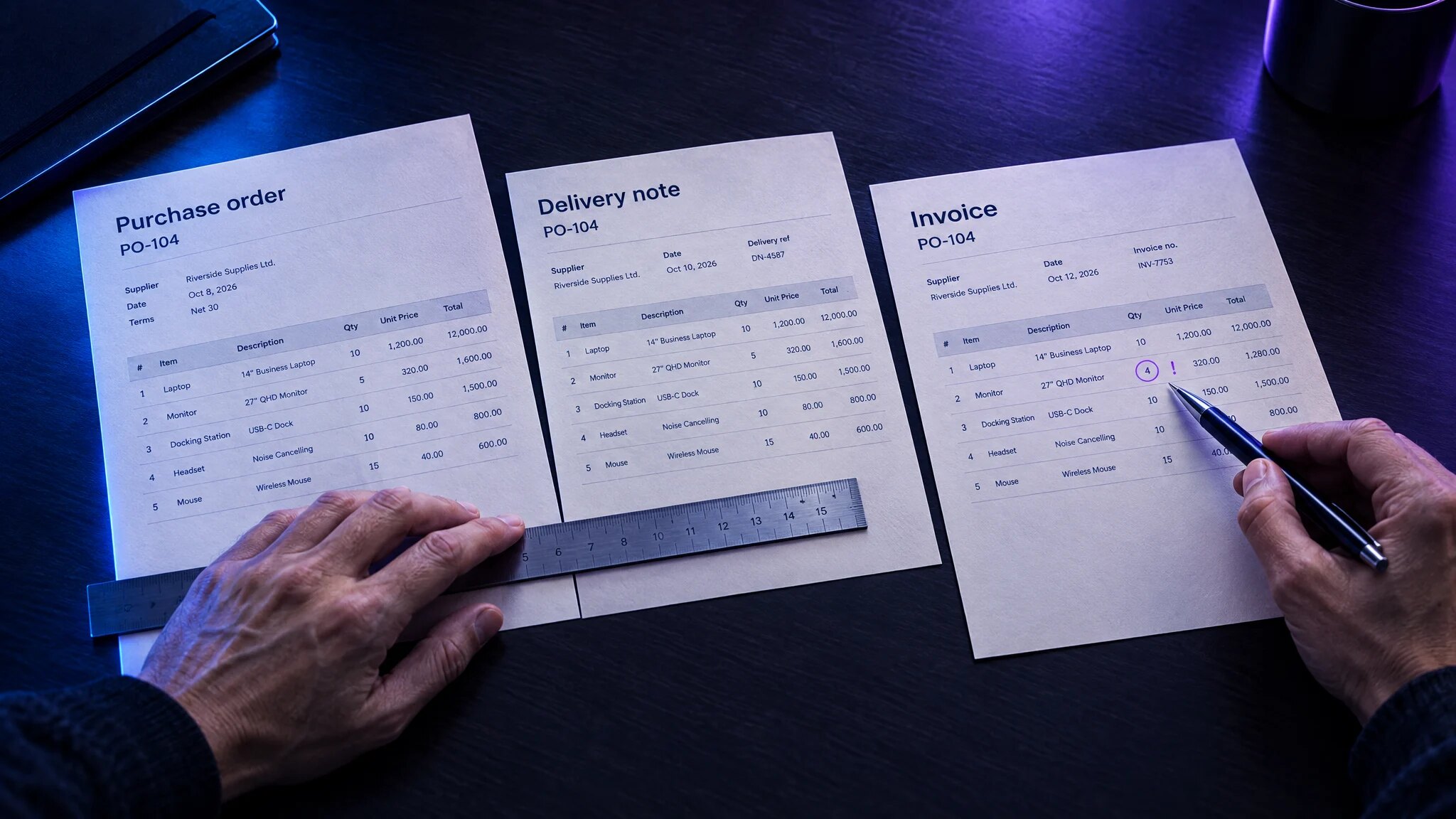
An invoice can be read perfectly and still be wrong to approve.
Imagine a supplier bills for 100 units. The purchase order requests 100. The delivery note records 80. An AI tool could extract every number correctly and still miss the problem if it treats each document as a separate job.
That is a hypothetical example, but it points to a useful product boundary. Reading the documents is one task. Deciding how their contents relate is another.
On October 6, 2026, Upstage announced a new version of Studio, describing workflows that connect contracts, invoices, and other records with human oversight. On October 1, LlamaIndex introduced Extract v2.5, including improved source citations on its Agentic and Agentic Plus tiers.
These are vendor announcements, not proof that your customer’s workflow is solved. They do show useful building blocks for a founder who understands the documents and the decisions around them.
Start with the comparison someone already makes
Do not begin with a promise to automate every PDF in an industry.
Ask a potential customer to show you one recurring comparison. Which documents do they open together? Which fields do they check? What makes them stop and ask a colleague?
For a procurement professional, that might be comparing an invoice with an order and a delivery record. For a training provider, it might be checking attendance records against completion requirements. Choose the process you actually understand.
Write down the finish line before choosing the extraction tool. A useful first product might prepare a reviewable exception list. It does not need authority to approve payment or change an official record.
Your experience matters here because a document label rarely explains the whole job. You know whether partial deliveries are normal, whether a revised order replaces the original, and who decides which exceptions are acceptable.
Define what counts as the same record
A schema is the list of fields and data types you want the tool to return. It might ask for an order reference, item code, quantity, unit, and delivery date.
That is necessary. It is not a matching policy.
In the procurement example, define how records connect before comparing their values:
- Which identifier links an invoice to an order?
- Which item code links individual rows?
- How do you handle two deliveries against one order?
- What happens when a reference is missing or matches several records?
- Are quantities expressed in individual items, boxes, or another unit?
Never let a similar supplier name silently stand in for a confirmed match. Treat ambiguous connections as unresolved until the reviewer can inspect them.
Keep original values beside normalized ones. If your workflow converts boxes into individual items, preserve the source quantity and the approved conversion rule. Otherwise, a correct calculation can become impossible to explain.
These rules are part of your product specification. A no-code builder can help implement them, but you must make them explicit first.
Keep evidence beside each extracted field
A reviewer should be able to move from a disputed value to the exact source that supports it.
LlamaIndex says Extract v2.5’s Advanced Citations locate bounding boxes around supporting evidence, including difficult fields whose values do not appear word for word in the document. That capability is available on Agentic and Agentic Plus, not every tier.
LandingAI’s September 8 Gen2 announcement describes a similar emphasis on traceability. Its DPT-3 Pro parsing model provides line-level grounding, while DPT-3 Verity, described there as a public preview, provides word-level grounding and confidence scores.
Grounding means linking output back to supporting source material. It does not prove that you selected the right document, matched the right row, or applied the right business rule.
Design your review output to retain the document reference, page, extracted value, and source location. Keep any calculated result separate from the literal text. If evidence is unavailable, show that limitation instead of presenting an unsupported value as settled.
Choose tools by testing this review experience. A citation that exists in an API response is useful only if your product preserves it and makes it accessible.
Test missing data, not just wrong data
A polished table can look complete while omitting the one row that changes the decision.
LlamaIndex’s release describes long lists, records spanning pages, and annotated scans as extraction challenges. Use those categories to build your own small test set. Do not assume the vendor’s benchmark results transfer to your documents.
Include synthetic or appropriately authorized examples with:
- An item row continuing onto the next page.
- Two similar documents with different order references.
- A handwritten correction beside a printed quantity.
- A missing delivery note.
- The same file uploaded twice.
- A cancelled line that should remain visible but not count as an active order.
Check completeness separately from field accuracy. Ask whether all expected documents and rows arrived before checking whether their values are correct.
Then check the business result. Did the product connect the correct records? Did it flag the missing evidence? Could the reviewer understand the reason without reconstructing the entire job?
For your first pilot, keep consequential decisions with the customer. Start by preparing comparisons and exceptions, then measure whether that preparation actually reduces their review work.
Sell the reviewed outcome
The offer should describe a finished job, not a technical capability.
“Extract data from PDFs” describes a component. “Prepare supplier invoice exceptions with the supporting order and delivery evidence” describes a specific workflow a buyer can evaluate.
Run a narrow pilot with one document family and one accountable reviewer. Agree on what counts as success before starting. Track review time, missed discrepancies, false alarms, and unresolved matches. Include the time you spend correcting extraction or maintaining matching rules in your delivery costs.
Ask whether the customer wants to keep using the result and what they would pay for continued delivery. Do not infer demand from enthusiasm for the demo.
If you later seek funding, this gives you concrete evidence to discuss. You can explain the recurring job, the customer’s use, and the work required to deliver it. A document count alone cannot answer those questions.
Your advantage is the comparison you know how to make. Use AI to prepare the evidence, encode the rules you can explain, and build around the decision your customer already needs.
AI Product Accelerator is a 12-week, mentor-led program for turning your experience into a product you build, launch, and own. Explore the program if you want a structured path to test your idea and plan your first pilot.